[This] story...pushes us beyond the parameters of what we've been saying about consent: That "no means no", or to seek an active "yes". This form of teaching consent focuses on feelings of power during intimacy. It's a response to a request—"will they let me have sex with them?"—rather than seeing sex as something mutual. The question should be, "Do they want to have sex with me?" That is essentially where this conversation lies. Is consenting about "wanting" or about "letting"?That's almost right, I think. But the real lesson, which seems to run just under the surface of a lot of these discussions, concerns the limitations of the notion of consent. In fact, this is not a new idea. See this piece by Rebecca Traister in The Cut, for example. But perhaps it's an idea who time has come.
Showing posts with label consent. Show all posts
Showing posts with label consent. Show all posts
Wednesday, January 17, 2018
The Inadequacy of Sexual Consent?
Earlier today, I fell down one of those Internet rabbit holes reading reflections about the Aziz Ansari story. (I confess to having previously had no idea who he was.) In truth, I jumped in myself, once I realized what was really at stake here, since it's something in which I've been increasingly interested myself over the last couple years. The best piece I read was by Amanda Alcantara, on The Lily. Here's the crucial bit:

Thursday, June 16, 2016
Wednesday, May 18, 2016
Amazing Reflection on Sexuality and Sexual Violence
On Feministing:
When I started having sex, disposability was the first thing on the menu. Fuck you, ignore you, make fun of you on Facebook. Even now, it is the public penance exacted from women who dare.And that's just the part about sexuality.
A friend of mine said as much at the end of our first semester of college. ...“Boys aren’t going to want to date you if you keep having sex with them,” my friend said. The words smashed against my face like ice or glass.
Tuesday, April 26, 2016
Every Woman Has Been a Little Bit Raped
Terrific piece on Role Reboot about why we (as a culture) need to broaden our understanding of rape and sexual assault. See also this piece on Bustle and this follow-up piece.
One of the most striking things to me was the idea, apparently expressed as often by women as by men, that stopping in the middle of sex "robs a man of his orgasm". This is particularly odd given that what's being discussed here, for the most part, is stopping intercourse. There's no indication, for example, in the Bustle piece that the author wouldn't have been happy to continue having some other sort of sex. Of course, it's her right not to stop altogether, if that's what she wants to do, but, as I said, that's actually not what seems to be at issue in most of these stories. There are other ways a guy can have an orgasm, you know?
One of the most striking things to me was the idea, apparently expressed as often by women as by men, that stopping in the middle of sex "robs a man of his orgasm". This is particularly odd given that what's being discussed here, for the most part, is stopping intercourse. There's no indication, for example, in the Bustle piece that the author wouldn't have been happy to continue having some other sort of sex. Of course, it's her right not to stop altogether, if that's what she wants to do, but, as I said, that's actually not what seems to be at issue in most of these stories. There are other ways a guy can have an orgasm, you know?
Monday, December 14, 2015
Amazing Photo Essay on Consent
"Face Value is a series of photographs, taken by staff photographer Aubrey Schuring, that showcase the emotions of various human beings as they discuss moments of consent, assault, and their feelings of worth with Project Consent."
See it on Project Consent.
See it on Project Consent.
Tuesday, November 4, 2014
Alcohol and Consent
I post a lot of links to what Thomas MacAulay Millar writes about consent, because so much of it is so sensible. And his recent piece "Draining the Swamp: Alcohol and Agency" is no exception.
Here's the first graph:
It's hard to have this conversation without it devolving into victim-blaming. Why? Because too many people want to blame victims. But we need to have this conversation.
Thomas's piece is in part a commentary on another article about alcohol and consent on HuffPo by Yvonne Fulbright, who argues that "we need to address the fact that many young people feel like they need to get drunk in order to be sexual and sexually active". And what's striking is that her proposals have nothing to do with alcohol.
Here's the first graph:
The way to handle the relationship between alcohol and alcohol-facilitated rape isn't to adopt some prohibition-lite approach that shames people (women; it's usually women that get shamed for pleasures of the flesh). Not only is it wrong, it doesn't even work. The way to deal with it is to recognize that shame and discomfort around sex incentivize the connection between alcohol and sexual situations. If we want to reduce the rate at which potential victims of sexual assault are intoxicated, the smart solution is to reduce the incentives to intoxicate.
It's hard to have this conversation without it devolving into victim-blaming. Why? Because too many people want to blame victims. But we need to have this conversation.
Thomas's piece is in part a commentary on another article about alcohol and consent on HuffPo by Yvonne Fulbright, who argues that "we need to address the fact that many young people feel like they need to get drunk in order to be sexual and sexually active". And what's striking is that her proposals have nothing to do with alcohol.
-- Schools implementing age appropriate, medically accurate, comprehensive sexuality education from kindergarten through the 12th grade.But the more important point that Thomas makes is that we need to develop a culture in which women have the right to say "Yes", and not just the right to say "No". Those are, as he says, "inherently interdependent", and neither makes sense without the other. But the truth, culturally speaking, is that women still don't have a right to say "Yes".
-- Universities offering courses by qualified sexuality educators in the art of seduction, romance, desires, sex communication, and reciprocal pleasures, helping students to realize what it truly means to be sexually confident. As a new, catchy slogan says, "Put the Sensual in Consensual!"
-- College campuses hosting Intimacy 101 workshops, which provide young people with a reality check around the many issues related to being sexually active, and which challenge misconceptions around better sex, including those of drunk versus sober sex.
-- Medical facilities offering accessible, affordable, first-rate sexual and reproductive health services.
-- Community centers, churches/synagogues, media outlets, and schools providing parents and caregivers with information and guidance in how to have effective conversations about sex and relationships with youth.
-- Parents and other important others guiding youth around matters of sexual intimacy, equipping them with the knowledge and skills needed to evaluate their own sex-related values, attitudes and beliefs systems in making better choices for themselves.
Yet More About Consent
Kind of basic stuff here, but worth reading. The nice point is that one doesn't have to go so far as to satisfy the legal definition of rape to violate consent in a way that does harm.

- "Coerced Consent: When 'Yes' Really Means 'No'" (Harris O'Malley, Good Men Project)
- "Consent Is Way More Complicated For Women Than Just 'Yes Means Yes'" (Samantha Eyler, Role Reboot)
- "6 Myths About 'Yes Means Yes'" (Soraya Chemaly, Role Reboot)
- "Neutral Evil: The Problem With Refusing To Decide" (Thomas MacAulay Millar, Yes Means Yes)
Sunday, November 2, 2014
More on Consent, Assault, and the Like
Just to be clear: I couldn't care less about Jian Ghomeshi. I'd never heard of the guy until a week or so ago. But when these sorts of things happen, and you see and hear the kinds of reactions we have seen and heard, it's a teachable moment. And it's an especially good moment for men to shut the fuck up for one freaking moment and listen to what the women around us are saying about their lives and their experience.
In that spirit, here is some more reading material.
In that spirit, here is some more reading material.
- "Why I Can't Remain Silent About What Jian Did to Me" (Reva Seth, HuffPo Canada)
- "As a Sex Assault Victim, I Know Why Jian's Accusers Didn't Call the Police" (Jill Amery, HuffPo Canada)
- "Jian Ghomeshi, the CBC and Rape Culture" (Yandie, Goddess of Pickles, Feministe)
- "Jian Ghomeshi, Sexual Violence, and the Presumption of Innocence" (Anne Thériault, Vice)
- "What Jian Ghomeshi’s Accusers Were Afraid Of" (Anna North, New York Times Opinion Pages)
Saturday, November 1, 2014
Good Reads: Consent, Ghomeshi, BDSM
This is an oldie but a goodie. The basic point is that people rarely refuse an invitation of any kind by saying "No". To the contrary, refusals are usually hedged in various ways, to soften the blow. The lesson is that people who violate consent don't "not understand". They don't want to understand.
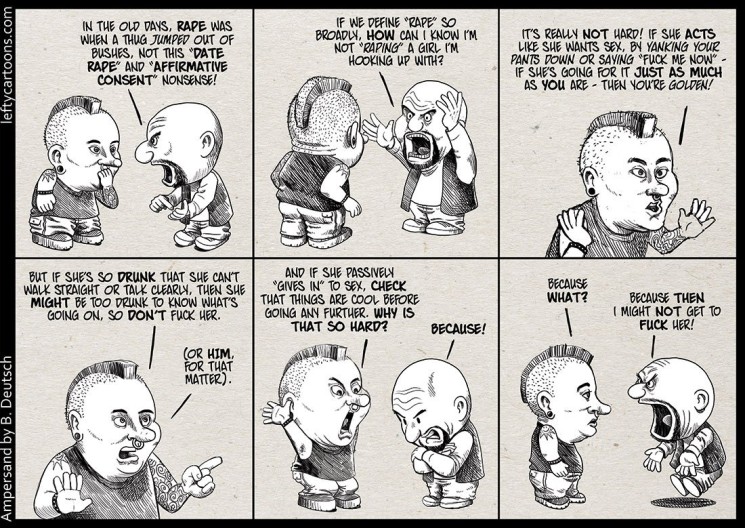
While we're at it: Here's a nice cartoon that explains what the real objection is to affirmative consent.
(Via Everyday Feminism).
- "Mythcommunication" (Yes Means Yes)
- "The Missing Stair" (The Pervocracy)
- "Not What We Do" (Yes Means Yes)
- "Ghomeshi: The Developing Story, And Predator Theory Observations" (Yes Means Yes)
- "Jian Ghomeshi Isn’t the First Alleged Abuser to Cite the Right to BDSM Sexuality" (The Cut)
- "Do You Know About Jian?" (Nothing in Winnipeg)
- "I Knew About Jian Ghomeshi" (Slate XX)
While we're at it: Here's a nice cartoon that explains what the real objection is to affirmative consent.
(Via Everyday Feminism).
Wednesday, October 1, 2014
Two Great Pieces on California's New Affirmative Consent Law
A couple days ago, Gov. Jerry Brown signed a new law in California establishing "yes means yes" as the standard by which sexual consent must be judged by colleges in California, rather than "no means no". Feminists, and other decent people, too, have been pushing for this sort of change for years, and it is important. Symbolically, it recognizes in the law that women are sexual agents and subjects of desire, not just passive objects of male sexual desire whose only choice point is to say "NO!!"
Here are two excellent articles about the new law:
The alternative against which he argues is a "commodity" or "transactional" model of sex in which women have something men want; the man's goal is to get the woman to give it to him; and the woman's goal is to make sure she gets something (e.g., emotional connection, a call in the morning, a wedding ring) in return. It's easy enough to see (and Thomas and others spell it out, if you can't see it) how that sort of model reinforces rape culture. It's also easy to see how deeply the commodity model is embedded in American attitudes about sex. See here and here for connections to "purity pledges", and of course Jessica Valenti's book The Purity Myth.
But maybe the coolest thing on this topic is this video by Canadian sex educator Karen C. B. Chan, which compares sex to a jam session.
Here are two excellent articles about the new law:
- "Do Not Fear California's New Affirmative Consent Law" (Amanda Marcotte, Slate Double X)
- "California’s Affirmative Consent Law: Beyond The Bullshit" (Thomas Macaulay Millar, Yes Means Yes)
- "What Affirmative Consent Looks Like" (Charlie Glickman) [added, via Good Men Project]
The alternative against which he argues is a "commodity" or "transactional" model of sex in which women have something men want; the man's goal is to get the woman to give it to him; and the woman's goal is to make sure she gets something (e.g., emotional connection, a call in the morning, a wedding ring) in return. It's easy enough to see (and Thomas and others spell it out, if you can't see it) how that sort of model reinforces rape culture. It's also easy to see how deeply the commodity model is embedded in American attitudes about sex. See here and here for connections to "purity pledges", and of course Jessica Valenti's book The Purity Myth.
But maybe the coolest thing on this topic is this video by Canadian sex educator Karen C. B. Chan, which compares sex to a jam session.
Tuesday, February 5, 2013
Sex as a Jam Session
There's something extremely important happening in feminist re-thinkings of the nature of sexual consent. Namely: the idea that there is something seriously wrong with the language of "consent"; that this language embodies a certain model of sexual interaction that is itself part of the problem. The locus of this work is the book "Yes Means Yes!" and an associated blog. There's no way I can spell out all the ideas here. The rough idea is that there is something oppositional about the language of consent and the "commodity model" of sex that underlies it. Person A has something person B wants, and so B asks A's permission to take or borrow or use it. When you see sex that way, you are just asking for people to take or borrow or use when A doesn't give permission.
So, the suggestion is, we should instead see sex as collaboration. The key advantage to thinking this way is that it now follows immediately that rape isn't sex. Period. You can't force someone to collaborate with you.
Sex educator Karen K. B. Chan has produced a (non-explicit) video that promotes this way of thinking about sex. It is absolutely fantastic stuff. Everyone should see this.
So, the suggestion is, we should instead see sex as collaboration. The key advantage to thinking this way is that it now follows immediately that rape isn't sex. Period. You can't force someone to collaborate with you.
Sex educator Karen K. B. Chan has produced a (non-explicit) video that promotes this way of thinking about sex. It is absolutely fantastic stuff. Everyone should see this.
Subscribe to:
Posts (Atom)