Wednesday, September 2, 2020

Controlling the Zoom Whiteboard on an Android Tablet

There does not seem to be much documentation for Zoom whiteboard. And, to make it more confusing, it is quite different on the desktop and mobile platforms (at least in the PC/Android world). Here, then, is a quick guide. This is all verified on an Android tablet, but I'm hoping it also works on Apple etc.

When you first open the whiteboard, you won't be able to do anything. If you tap on it, though, you should see a small pencil icon at the lower left. I guess that means "Edit" (as if you wanted to stare a white screen instead). Press that. Now you should be able to write on the screen.

If you switch away to some other application, then the whiteboard may lock again, and you'll have to click the edit button again.

You will also see a row of icons across the bottom. 


 At far left:

  • An 'undo' button
  • A 'redo' button

At far right: 

  • A trash can: options for clearing the screen
  • A kind of rounded square with a plus sign: For creating another whiteboard. You can have up to 12. This can be convenient if you want to do something else and come back to what you had before.
    • Once you have more than one whiteboard, you will see to the left of the 'create' button a 'stack' of whiteboards with a number indicating how many you have. Press it and you will get a screen letting you select which whiteboard you want to use.
  • Three dots that expose more options, including "Smart Recognition") whatever that is, and an option for saving the whiteboard.
Most useful are the buttons in the middle. (You may need to click the > symbol at the right to see all of them.) From left to right:
  • A pencil: For drawing lines.
  • An eraser: For erasing stuff.
  • A series of colored dots or circles: For choosing the color of the pencil or highlighter.
  • A T: This allows you to type text on the whiteboard. Let me know if you can figure it out. I can't.
  • A squiggly line: For selecting the size of the pencil.
  • Something like an exclamation point tilted over: I think it's meant to look like a highlighter, since that's what it does. It uses a lighter, transparent version of whatever color is set.
  • A light stick: Works like a laser pointer.
One further note: If you intend to use this for serious teaching, you will want to get a high-precision stylus, such as this one. (It's just the one I happen to have.) Most laptop styli (let alone fingers) are too difficult to control with enough precision for writing.


Thursday, August 13, 2020

Use Your Tablet as a Whiteboard in Zoom

I have been thinking for a while that it must somehow be possible to use a tablet as a whiteboard in Zoom. It would be really nice to be able to do something like this for office hours. The advantage, of course, is that the tablet is made to be written on with a stylus, whereas using the Zoom whiteboard with the mouse is, in my experience, hopeless. (A high precision stylus definitely helps here, though.)

Turns out it is quite simple to do this.The key is that it is possible to sign into Zoom, with the same account, more than once. 

So, to try this out:

  1. Start a Zoom meeting from your main computer.
  2. Launch Zoom on your tablet and 'join' that same meeting, using the same login you used when you started the meeting. Tell Zoom not to start your video or audio. (That will already be working from the other device. It's just weird to see yourself twice. Trust me.)
  3. Now start screen sharing on your tablet and choose "Whiteboard". (On my tablet, I can also share my 'Screen' and thereby share any other app, though this is quite slow.) 

Note that, even if you have limited screen sharing to 'host only', this will work, since you are the host and are just signed in twice. And you absolutely should be limiting screen sharing, as a security measure.


This later post discusses how to use the whiteboard.

Thursday, June 25, 2020

Published: The Birth of Semantics

Written with Robert May and just published in Journal for the History of Analytical Philosophy.

Abstract:
We attempt here to trace the evolution of Frege's thought about truth. What most frames the way we approach the problem is a recognition that hardly any of Frege's most familiar claims about truth appear in his earliest work. We argue that Frege's mature views about truth emerge from a fundamental re-thinking of the nature of logic instigated, in large part, with a sustained engagement with the work of George Boole and his followers, after the publication of Begriffsschrift and the appearance of critical reviews by members of the Boolean school.
Find it here.

Friday, June 5, 2020

Hope

I am cautiously hopeful that things really have shifted this time, for the better. The protests are, in reality, peaceful. They have not just stopped this time. Read about Drew Brees. Would he have been corrected the same way three years ago? Would he have apologized? Would there have been utter silence from the right wing and State News?

Try sitting still for 8 minutes and 42 seconds and then tell me your answer.

Sunday, April 26, 2020

Another Night

Albums from another night of listening....

  • Duke Ellington, Such Sweet Thunder (Columbia, 1957)
    This is Duke's Shakespeare suite, and it is a really fantastic album. It's a relatively small version of the Ellington orchestra, and they are in great form here. Mono only, unfortunately, though, timbrally speaking, it is a great recording. I'm privileged to own a white label promo that is in terrific condition.
  • Gary Burton and Chick Corea, Crystal Silence (ECM, 1973)
    I am a big fan of Gary Burton. I am not a huge fan of Chick Corea, though there are albums of his that I love, and this is one of them. (Circle is another.) There is something amazing about the combination of piano and vibes here, all the more so because of how these two play off each other.
    I always think of this album as quiet and meditative, and there are times it is like that, but not always. Still, I needed this album on this day, when my uncle was dying of Covid. I'm glad it was there for me.
  • Oregon, Winter Light (Vanguard, 1974)
    I thought I'd posted about this album before, because I'd listened to it a while back. Anyway, I had to have another listen because I got an original pressing, whereas the other one was a later re-issue in Vanguard's "MidLine" series. This one sounds a lot better, probably (as usual) because of tape degradation. But what matters here is the music, and it is fantastic. If you were only ever to listen to one album by these guys, this might be the one.
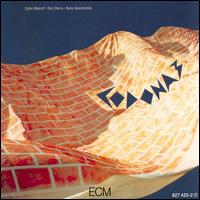
  • Collin Walcott, Don Cherry, and Nana Vasconcelos, Codona 2 (ECM, 1981) and Codona 3 (ECM, 1983)
    I listened to these two albums while hacking on LyX, so I don't have as much to say about them as I might otherwise. But they're terrific albums. Walcott really shines here, when given the chance to be more of the focal point (as he is not always with Oregon).

New Paper: Does Pornography Presuppose Rape Myths?

Abstract:
Rae Langton and Caroline West have argued that pornography silences women by presupposing misogynistic attitudes, such as that women enjoy being raped. More precisely, they claim that a somewhat infamous pictorial, “Dirty Pool”, makes such presuppositions. I argue for four claims. (i) Langton and West's account of how pornography silences women is empirically dubious. (ii) There is no evidence that very much pornography makes the sorts of presuppositions they require. (iii) Even "Dirty Pool", for all its other problems, does not make the presuppositions that Langton and West claim it does. (iv) Langton and West misread “Dirty Pool” because they do not take proper account of the fact that pornography traffics in sexual fantasy.
Get it here.

Sunday, April 12, 2020

Happy 80th, Herbie

The other day, I listened to Herbie Hancock's first solo album, Takin' Off, and later was googling for more info about it, and realized that he is going to be 80 years old today, 12 April 2020! Happy birthday, Herbie!! So, of course, tonight had to involve some Herbie.