Showing posts with label music. Show all posts

Sunday, December 21, 2025

John Coltrane, Jazz Piano Solos v. 24

Yet another book of solo piano arrangements, this time of tunes either written by or recorded by John Coltrane. The ones he wrote (most of them, at least) cannot be 'played', as of this writing, presumably due to the need to pay royalties for such 'playing'.

The arrangements in this book are by Brent Edstrom.

Sunday, December 1, 2024

Pat Metheny (Jazz Piano Solos, v. 57)

Another volume of solo piano arrangements, this time of tunes by Pat Metheny (and in some cases Lyle Mays).

Quite a few people of my generation seem to know of Metheny only from the Pat Metheny Group recordings. I happen to think those are amazing, but I know they do not always appeal to jazz purists. But it would be a huge mistake to think Metheny is defined by those recordings. Check out albums like 80/81, Question and Answer, Day Trip, and the recent solo acoustic recordings, such as Moon Dial. Metheny does straight jazz, too. And he writes incredible ballads!

Duke Ellington (Jazz Piano Solos, v. 9)

I am a HUGE Duke Ellington fan. He wrote so much great music, and his band, at its peak, was just incredibly powerful. The great classic is Ellington at Newport, from 1956, which relaunched his career and contains one of the greatest sax solos ever. And there are Jazz Party in Stereo and the great suite Black, Brown and Beige. Not to mention the Concert of Sacred Music, which still blows me away.

I was reading a book about jazz music theory a little while ago. Repeatedly, it would say things like: Jazz musicians didn't relaly start using suspended chords until the 1960s. Except Duke, who was using them in the 30s. He was so far ahead of everyone else that it is ridiculous. 

And if you don't know albums like Money Jungle (with Charles Mingus and Max Roach), then you are in for a real treat: Duke could play 'outside', too. And don't forget the amazing album he made with Coltrane in the early 60s.

This book contains arrangements of some of Duke's music. The links below are to 'official' scores on Musescore, meaning you can't download them without paying, but the complete sheet music is there, and you could play them off a tablet or something. Most helpfully, you can listen to at least some of them (played via MIDI), which is great for getting the rhythms right.

Friday, November 29, 2024

Miles Davis (Jazz Piano Solos, v. 1)

Another post of links to Musescore versions of arrangements of jazz standards. This one is of Miles Davis tunes---mostly ones he wrote, and others he recorded. The difficulty ranges from things I can play (intermediate level) to things it'll be a while until I can play. 

These are 'official' scores, meaning you can't download these 'official' scores without paying (and I've already paid for the books, thank you), but the complete sheet music is there, and you could play them off a tablet or something. Most helpfully, you can listen to them (played via MIDI), which is great for getting the rhythms right.

Jazz Fusion (Jazz Piano Solos, v. 54)

Hal Leonard publishes some really great collections of piano solo arrangements of jazz standards. The difficulty ranges from things I can play (intermediate level) to things it'll be a while until I can play. The tunes in this particular book are definitely on the harder side.

These do not come with recordings, even online. Fortunately, they have started putting them on MuseScore. Not all the songs are there, presumably due to issues around who owns the copyright. You can't download these 'official' scores without paying (and I've already paid for the books, thank you), but the complete sheet music is there, and you could play them off a tablet or something. Most helpfully, you can listen to them (played via MIDI), which is great for getting the rhythms right.

Tuesday, November 26, 2024

Jazz Ballads (Jazz Piano Solos, v. 10)

Most of these are on MuseScore, as 'official' scores. That means they cannot be printed or downloaded without paying. But the full sheet music is there, so you could play them off a tablet or something. And many of them, at least, can be listened to. It's nice to be able to hear them when trying to learn the arrangement (and before deciding whether to bother).

Monday, November 25, 2024

Burgmüller, 25 Easy and Progressive Studies, Op. 100

These are nice pieces for someone at my level: They get more difficult as they go, and they're not boring. You can download the music from IMSLP. There are lots of YouTube videos about these, too.

Schirmer's Giant Book of Intermediate Classical Piano Music

This book contains 269 pieces by 3 composers, covering early intermediate and, I guess, just 'intermediate'. (There is a separate book of 'upper' intermediate pieces.) Some of these are also in the Early Intermediate book.

The links below are to scores on MuseScore.com, which you can both download and play, in most cases, so you can hear the piece while trying to learn it. The 'official scores' cannot be downloaded or printed, without payment, and cannot always be listened to, at this time, though my sense is that more and more of them can be. I've also included links, in some cases, to IMSLP.org, the Petrucci Music Library.

Tuesday, November 28, 2023

Schirmer's Early Intermediate Level Masterpieces

During the pandemic, I started teaching myself piano. Recently, I've been working my way through a book of 'selected piano masterpieces' from Schirmer's Library of Musical Classics: Early Intermediate Level. Of course, this is all public domain, and you can get the music online, but it's nice to have it in a book.

That said, it's also nice to be able to hear the pieces, and for that I've been using MuseScore, which is open source music notation software that will also 'play' whatever you enter into it. There's also a huge library of music that various people have uploaded into it, including a lot of the 'classics'. 

So here's a list of links to versions of the pieces in the mentioned book. Note that you can download these or play them directly from the site. Please let me know if any of the links should break.

Tuesday, August 8, 2023

Musical Tempo Markings

I've not found an easily printable list of these online, so here's one. 


Larghissimo Very, very slow 20 bpm or slower
Solenne/Grave Slow and solemn 20 - 40 bpm
Lento Slowly 40 - 60 bpm
Lentissimo At a very slow tempo 48 bpm or slower
Largo Broadly 40 - 60 bpm
Larghetto Rather broadly 60 - 66 bpm
Adagio At ease, slow and stately 66 - 76 bpm
Adagietto Rather slow 70 - 80 bpm
Tranquillo Tranquil, calmly, or peaceful 80 bpm
Andante At a walking pace, moderately slow 72 - 76 bpm
Andantino Slighlty faster and more light-hearted than Andante 73 - 83 bpm
Andante moderato Between Andante and Moderato 92 - 98 bpm
Moderato Moderately 108 - 120 bpm
Allegretto Moderately fast, but less than allegro 100 - 128 bpm
Allegro moderato Moderately quick, almost Allegro 116 - 120 bpm
Allegro Fast, quickly and bright 120 - 156 bpm
Vivace Briskly, Lively and fast 156 - 176 bpm
Vivacissimo Very fast and lively, faster than Vivace 172 - 176 bpm
Allegrissimo or Allegro vivace Very Fast 172 - 176 bpm
Presto Very, very fast 168 - 200 bpm
Prestissimo Faster than Presto 200+ bpm

Sunday, March 19, 2023

Compiling Ardour on Fedora

Ardour is an open source Digital Audio Workstation that runs on Linux, OSX, and Windows. They provide binaries, but require payment for them. I'll probably subscribe, just to help them out, but I decided to compile it myself first, so I could check it out. To do that, I had to install a number of libraries. Namely, these ones:

boost boost-devel glibmm2.4-devel sndfile-devel sndfile libsndfile-devel libcurl-devel libarchive-devel libcurl-devel liblo-devel taglib-devel vamp-plugin-sdk-devel rubberband-devel aubio-devel lv2-devel serd-devel sord-devel libudev-devel libusb-devel libusb1-devel cppunit-devel  libwebsockets-devel pangomm*devel liblrdf-devel sratom-devel lilv-devel lilv-{devel,libs} gtkmm*devel

I don't think I needed absolutely all of that, and you may need to install other things, too, but that will get you going.

Once the headers were installed, compilation was pretty painless.

Monday, December 12, 2022

Within Temptaton: Enter

The appropriately named Enter is the first album from the Dutch symphonic metal band Within Temptation (who just finished a tour of the US opening for Iron Maiden). They had also released an EP, Restless, in 1997.

It's really quite varied, ranging from almost purely orchestral pieces to some pretty heavy metal. Sharon den Adel, the vocalist, has the usual amazing voice that seems to characterize these bands. It's not just that she sounds pretty, but she really knows how to use those pipes, as well. Like many symphonic metal bands, though, the vocals mix the 'clean' sound of den Adel's voice with growled vocals from Robert Westerholt. This is the so-called 'beauty and the beast' effect.

For a first album, this is really very impressive. Their sound is well established. And although their music is not as complex as that of Epica or Nightwish or Ayreon, it's still got more than enough to keep me interested, and that's not always easy to do.

The real highlight for me is "Gatekeeper", which is one of the heavier numbers on the album. It opens with a lovely orchestral passage which flows smoothly into heavily distorted guitars, which eases back into a more orchestral section, though that's overlayed with drums. The introduction complete, the song moves into a second section, featuring power chords and then a simple but effective guitar riff. The vocals begin in the growled style, with choral voices behind, until Den Adel at the chorus. It's really a powerful song.

Epica: The Phantom Agony

The first of the symphonic metal bands I discovered was Epica, which was founded by Mark Jansen, who has previously been in one the first symphonic metal bands, After Forever. As it happened, he was dating Simone Simons at the time, who could sing, so he invited her to front the band. And damn can she sing! (Check out her performance, with Floor Jansen, of "Stabat Mater" on Retrospect.)

I'm working my way through their catalog. Having started my own listening with some more recent stuff, I've gone back to the beginning.

The first album, released in 2002, was The Phantom Agony. It opens with a statement of intent, the choral piece "Adyta", sliding smoothly into a pretty typical sort of Epica piece in "Sensorium". But things really get going with the third song, "Cry For the Moon", which seems to remain a favorite with a lot of Epicans (as fans are known). It's very much symphonic metal, with symphonic elements but a driving metal beat, Simons's gorgeous vocals backed by a choir (though her voice may be overdubbed as part of that, too). 

That song is a continuation of a song cycle, "The Embrace That Smothers" that Jansen had begun with After Forever. Wikipedia describes it as being about 'the dangers of organized religion', which would be putting it kindly. Two more parts appear hear, the rest being on The Divine Conspiracy. I mean at some point to listen to all nine parts of it together.

Much of the rest of the album has a similar theme. Indeed, the whole thing feels like a concept album, organized around a person's search for meaning and struggle with religion.

It's not a mature effort. Jansen and Simons and the others are clearly still learning to harness their compositional talents. But the highlights here are fantastic, such as title track, especially.


Tuesday, December 6, 2022

After Forever

This afternoon, while doing various sorts of work, I listened to the first three albums by the Dutch symphonic metal band After Forever. One of the founding members of this band was Mark Jansen, who would later found Epica, and the vocalist was Floor Jansen (no relation), who is now the vocalist for Nightwish. Mark Jansen left after the second album; there were three more after that.

The first two albums are Prison of Desire and Decipher. I don't think these are quite up to what Mark Jansen would shortly do with Epica, but you can see the seeds of that music here. They do a great job integrating the orchestral elements with the rock elements, and Floor is, as always, just brilliant on vocals. (There are also growled, metal-style vocals, which Mark Jansen would continue with Epica. The contrast between these is sometimes called 'beauty and the beast'.)

The third album, Invisible Circle, is a really ambitious concept album, telling the story of an extremely dysfunctional family and how the cycle of abuse perpetuates itself. It's depressing and sad, as you'd expect, but insightful and powerful. It's not uniformly successful, but there is some pretty good stuff here. It's a bit more on the progressive metal end, with some obvious elements of bands like Yes and ELP. 

Indeed, it sometimes feels to me like Yes is a major influence (perhaps at a remove) on this stuff. A lot of the 'clean' female vocals remind me of Jon Anderson's vocal style. (Yeah, I'm very into Yes.)

Symphonic Metal

A couple months ago, I saw John Petrucci, from Dream Theater, touring in support of his solo album Terminal Velocity. It was a great show. Opening was Meanstreak, whom I'd not heard of before. As it turns out, they were one of the first all-woman metal bands, though they've been inactive for many years. (And, as it also happens, three of the women in the band would eventually marry members of Dream Theater.)

After the show, I did a lot of reading about women in metal, my curiosity piqued. I'm not, generally speaking, a big metal-head, but I have enjoyed some music of that kind. I really like Mastodon's albums Blood Mountain and, especially, Crack the Skye, and of course King Crimson, one of my all-time favorite bands, inspired a lot of metal, especially on the more progressive end.

Eventually, I stumbled upon 'symphonic' metal: These bands are often fronted by women. If you haven't heard this stuff, it may sound almost impossible. And it's easy to imagine how mixing metal with symphonic elements could go horribly wrong (as, indeed, it sometimes does). But the best bands in this tradition are just amazing, and I've been blown away by Epica and Nightwish, especially, and frantically started collecting their albums on vinyl. As it happened, Epica was playing up in Boston (opening for Sabaton) just a couple weeks after I saw Petrucci, so my partner and I were able to see them.

There are a lot of other bands in this tradition, and I'm going to use the blog to record some thoughts about some of them.

Sunday, April 26, 2020

Another Night

Albums from another night of listening....

  • Duke Ellington, Such Sweet Thunder (Columbia, 1957)
    This is Duke's Shakespeare suite, and it is a really fantastic album. It's a relatively small version of the Ellington orchestra, and they are in great form here. Mono only, unfortunately, though, timbrally speaking, it is a great recording. I'm privileged to own a white label promo that is in terrific condition.
  • Gary Burton and Chick Corea, Crystal Silence (ECM, 1973)
    I am a big fan of Gary Burton. I am not a huge fan of Chick Corea, though there are albums of his that I love, and this is one of them. (Circle is another.) There is something amazing about the combination of piano and vibes here, all the more so because of how these two play off each other.
    I always think of this album as quiet and meditative, and there are times it is like that, but not always. Still, I needed this album on this day, when my uncle was dying of Covid. I'm glad it was there for me.
  • Oregon, Winter Light (Vanguard, 1974)
    I thought I'd posted about this album before, because I'd listened to it a while back. Anyway, I had to have another listen because I got an original pressing, whereas the other one was a later re-issue in Vanguard's "MidLine" series. This one sounds a lot better, probably (as usual) because of tape degradation. But what matters here is the music, and it is fantastic. If you were only ever to listen to one album by these guys, this might be the one.
  • Collin Walcott, Don Cherry, and Nana Vasconcelos, Codona 2 (ECM, 1981) and Codona 3 (ECM, 1983)
    I listened to these two albums while hacking on LyX, so I don't have as much to say about them as I might otherwise. But they're terrific albums. Walcott really shines here, when given the chance to be more of the focal point (as he is not always with Oregon).

Sunday, April 12, 2020

Happy 80th, Herbie

The other day, I listened to Herbie Hancock's first solo album, Takin' Off, and later was googling for more info about it, and realized that he is going to be 80 years old today, 12 April 2020! Happy birthday, Herbie!! So, of course, tonight had to involve some Herbie.

Tuesday, April 7, 2020

Monday Evening Tunes

  • Jan Garbarek, Egberto Gismonti, and Charlie Haden, Folk Songs (ECM, 1981)
    A very nice album, but not breathtaking in the way that Magico was. It has its moments, but it lacks the lyrical flow of that album. Still, these are three amazing musicians, and there are some wonderful moments.
    As I mentioned, I think, with Magico, this album sounds especially wonderful on the new speakers, because they do such a great job with Haden's bass. It is deep and powerful, and just big, the way it should be.
  • Herbie Hancock, Takin' Off (Blue Note, 1962)
    This was Herbie's first album as a leader, at the ripe age of 22. With Dexter Gordon and Freddie Hubbard, and a rhythm section of Butch Warren and Billy Higgins. It's a nice record, but for the most part it's also a pretty typical one for the label and the era. The slow ballad, "Alone and I", that closes the album is probably my favorite.
    Here's something kind of scary: This coming Sunday, 12 April 2020, is Herbie's 80th birthday.
    My copy is a 1970s "black b" pressing, and not an RVG master. So it's a touch dark, though it still sounds pretty good.
  • Duke Ellington, Jazz Party in Stereo (Columbia, 1959)
    What a fun record! The liner notes claim that Duke was just back from Florida, so they wanted to get a few tunes recorded, but then a whole bunch of people showed up to say hello, including Dizzy Gillespie and Jimmy Rushing, and it turned into a party. Including, at one point, two vibraphones, two xylophones, a glockenspiel, and nine tympanis, plus more conventional percussion. Great music and a great performance, including yet another long rip from Paul Gonsalves (though nothing approximating what is on Ellington at Newport).
    My copy is an original 6-eye pressing. It is far, far superior to the Classic re-issue, and probably cheaper.
    For audiophiles: This is a great recording, timbrally, and it has a ridiculously wide soundstage at times.
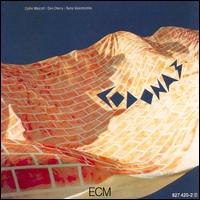
  • Collin Walcott, Don Cherry, and Naná Vasconcelos, Codona (ECM, 1978)
    I am guessing that this must have been one of the "Let's throw three amazing musicians together and see what happens" albums that ECM seemed to make from time to time. It's an interesting collection of folks: Walcott, from Oregon, on sitar, tablas, and dulcimer; Cherry, best known for his early work with Ornette Coleman, but by then well-established in his own right, who plays trumpet (as usual), a variety of flutes, and dousn'gouni; and Naná Vasconcelos, a Brazilian percussionist who, at that point, had recorded two albums for ECM with Egberto Gismonti. (He would later record one of my favorite albums, As Falls Wichita, So Falls Wichita Falls, with Pat Metheny and the late Lyle Mays.)
    This is a very weird album, as you might expect. It doesn't always work, but when it does it's really magical. The highlight, to me, is "Mumakata", though the other song on side 2, "New Light", is also wonderful.
    PS: CO (Collin), DO (Don), NA (Naná). (Kind of like NiRoPe, if you're from southeastern New England.)

Monday, March 30, 2020

ODroid Music Streamer (and FREE Roon Replacement)

I've been playing for a while now with an ODroid N2 and trying to build a music streamer from it. In some ways, that is not particularly difficult, but I'm trying to do it my own way, of course, which makes it more so. This page records the steps I've taken to get it working.1

Sunday, March 29, 2020

Birthday Music


  1. David Torn, Cloud About Mercury (ECM, 1986)
    If you're at all into progressive rock, and you don't know this album, you need to listen to it very soon. The rest of the band is Bill Bruford, Tony Levin---i.e., the rhythm section from the great King Crimson incaranation of the early 1980s---and Mark Isham on trumpet. Torn is a guitarist, and a very creative one.
    This is one of those genre-busting albums. It's somewhere between progressive rock and fusion, I guess.
  2. Jan Garbarek Group, It's OK to Listen to the Gray Voice (ECM, 1985)
    A stunningly beautiful album, with David Torn on guitar, Eberhard Weber on bass, and Michael DiPasqua on drums and percussion. The interplay between Torn and Garbarek, in particular, is worth the price of admission. And Weber plays bass like no one else.
    From here on out, it turned out to be mostly a night of Garbarek.
  3. Ralph Towner, Solstice (ECM, 1975)
    Another of my favorite albums, and one of the great ECM records. Garbarek and Weber are here again, along with Jon Christensen on drums. Somewhat unusually for jazz, Towner plays classical and 12-string guitars, and occasionally piano. This is more straight ahead jazz than one gets with Oregon, and there are just lovely textures between the acoustic guitars, Garbarek's sax, and Weber's electric upright bass.
    The recording is extraordinary. It's hard to over-state what a wonderful audio engineer Jan Erik Kongshaug was, and how much influence he must have had on the 'ECM sound'. Here, he gives us a wonderful sense for the softness of Towner's classical guitar and, at the same time, the power of Garbarek's sax.
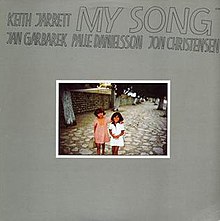
  4. Keith Jarrett, My Song (ECM, 1978)
    The second record from Jarrett's so-called 'European Quartet', with Garbarek, Christensen, and Palle Danielsson on bass. The only other studio album they made was Belonging, from 1975.
    This one is more lyrical than that one and less 'free' than Nude Ants (1979), which was recorded live at the Village Vanguard. A wonderful album.
  5. Keith Jarrett, Personal Mountains (ECM, 1989)
    Also from the European Quartet, recorded live in Tokyo in 1979. I would guess that this record maybe gives one more of a sense for what their concerts were really like. There's a lot of out-there improvisation, as on Nude Ants, but also more lyrical performances.